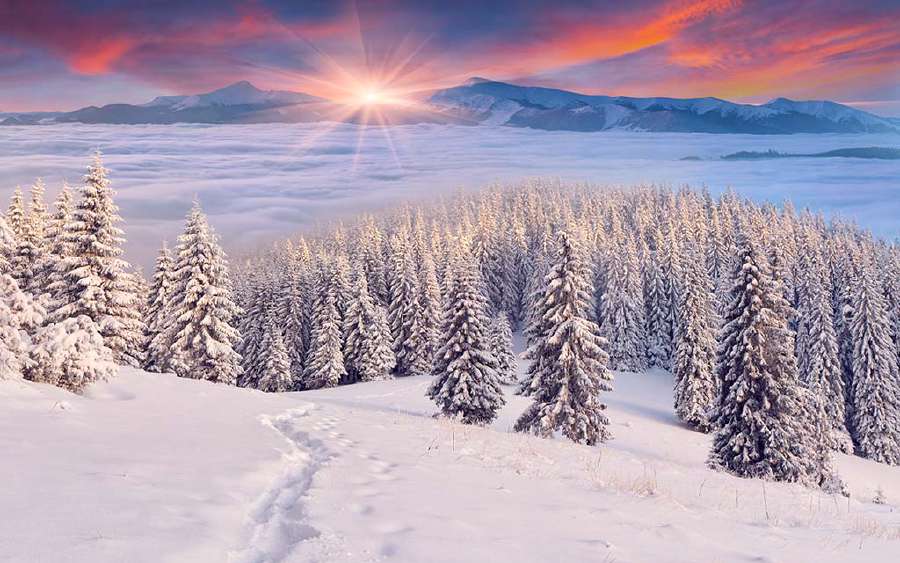
There are some things in nature that have a great capacity to toss back or reflect a great deal of the sun’s light that falls on them. One of them is snow. Newly formed snow reflects about 90 per cent of the sunlight that falls upon it. This means that the sun is powerless to melt clean snow. And when snow does melt, it is not because of the sunlight. Snow does not melt on a spring day because of the sun’s heat. It melts because of the warm air from the sea.
After snow becomes ice, a different problem arises. Clean ice absorbs about two-thirds of the sunlight that hits it – but ice is transparent enough for the light to penetrate quite a long way (10 metres or more) before the absorption takes place.
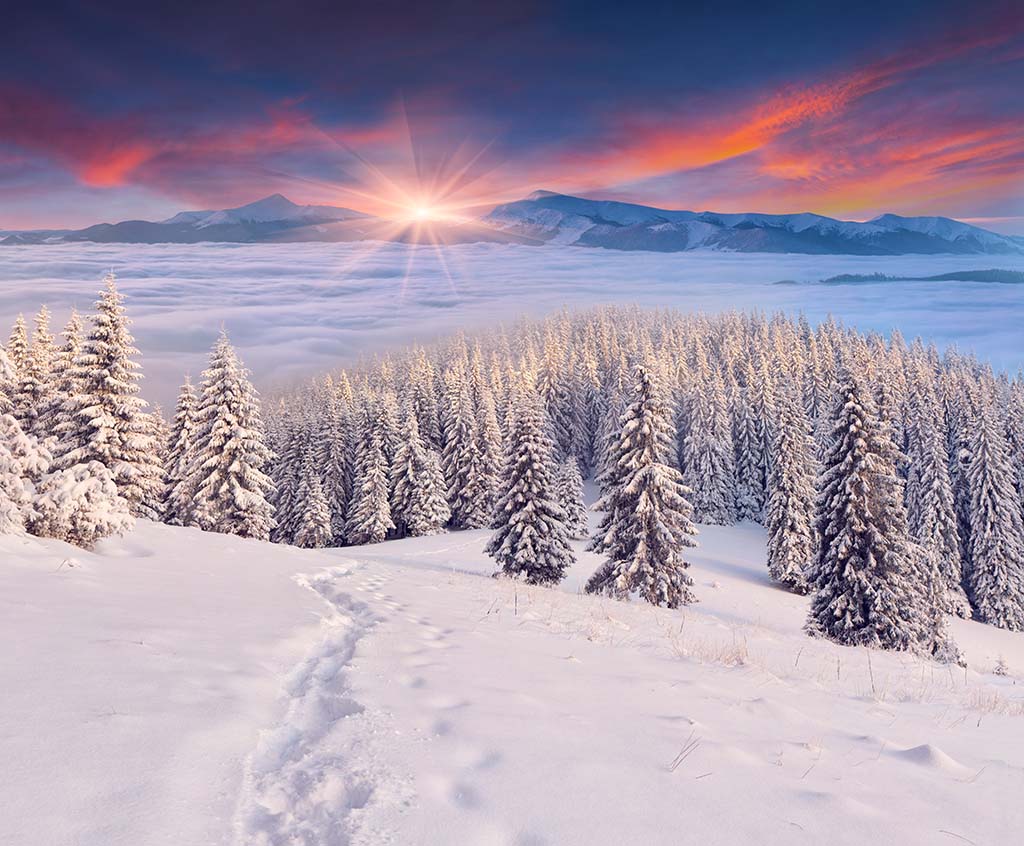
It is remarkable what profound results follow from this simple property of transparency to sunlight. If, instead of penetrating deeply, the light were absorbed in a shallow surface layer of ice, the summer sun would quickly raise the temperature of the thin surface layer to melting point. And almost immediately, the water would run off.
But when the sunlight penetrates a thick layer of ice before it can be absorbed, it cannot raise the temperature of the ice to melting point quickly enough. When the ice is very cold, the whole summer passes before any melting occurs at all. This is what happens today in the Antarctic, just as it must have happened in northern Europe during an Ice Age.
Just imagine, if by magic, ice were suddenly made opaque to light, the glaciers that exist today would melt away in a few years, raising the sea level by 60 metres or more. It would flood at least half the world’s population.
Simply amazing how so much depends on so simple a physical property!
Clouds toss back about 50 per cent of the light that hits them. Ice and deserts reflect 35 per cent. Land areas are generally a good deal lower in reflectivity – usually 10 to 20 per cent, depending on the nature of vegetation.
Oceans, which cover 71 per cent of the Earth’s surface, are least reflective of all – only about three per cent. That is why oceans appear dark in pictures of the Earth taken from the Moon or from artificial satellites.
When all the sources of reflection are added together, our planet is found to turn back into space some 36 per cent of the solar radiation falling upon it.
From the Woodpecker volume 2000, brought out by the Academy of Mountain Environics, an NGO based in Dehra Dun, in north India. Creating environmentally sustainable technologies at the local level is its main concern.
You may also be interested in these:
Why is the Mediterranean Sea Blue?
The Dark Kingdom of Uranus
Why's the Sun Red during Sunrise and Sunset?
The Secrets of the Ocean Floor
What is an Earthquake?