December 27: Leslie Readwin of Britain is in India with a purpose. She wants to see the famous tigers of the Corbett National Park, which nestles at the foot of the Indian Himalayas. The 80 year old is very keen to meet the majestic cats in their natural surroundings. But she might have to return without seeing even one.
The tiger is dying out at Corbett, a Park that was created with the very aim of preserving the region’s tigers.
Ms Readwin was born in India and was a teacher at the nearby Nainital hill station when she was young. It was during that time that she met the legendary tiger hunter Jim Corbett, after whom the park is named, writes
The Asian Age. Corbett had come to the school to deliver a lecture.
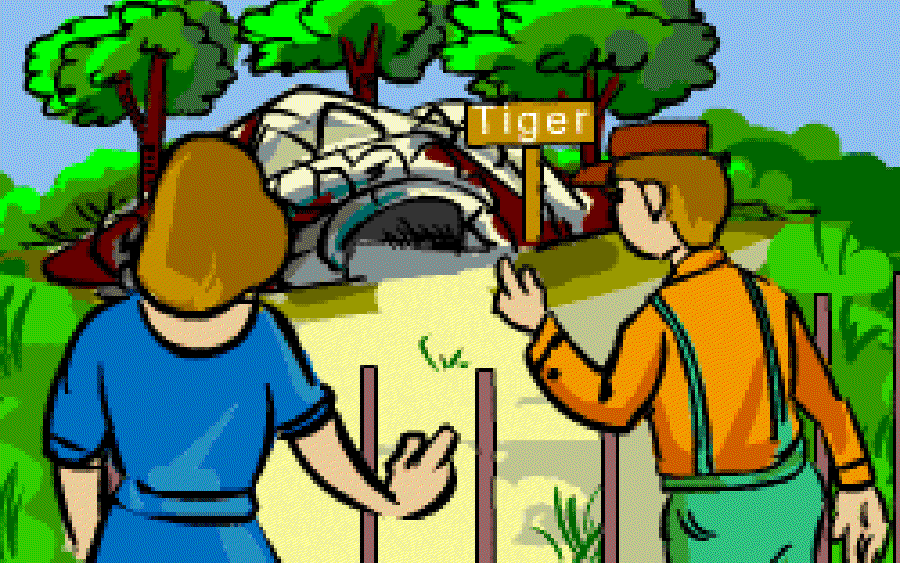
![Pushed to the Edge [Illustration by Anup Singh]](/media/news-india-141_1.gif)
Jim Corbett was an Englishman who lived in India during the days of the British. The Kumaon Hills, which are now part of the newly formed Indian state of Uttaranchal, were his hunting grounds.
In his book The Man-eaters of Kumaon, Corbett describes how he hunted tigers which preyed on humans instead of wildlife. He could be a ruthless hunter but he loved the wilds and the animals.
Finally, one day he decided to give up hunting and established the Corbett National Park in 1936. Established as a place of refuge for the striped cats, the Park has been a favourite with both tourists and serious tiger-watchers.
Leopards, crocodiles, monkeys and jackals also live in the 1,300 square kilometre national park and its surroundings. The tigers are there, too. It’s just that no one is sure how many there are. Estimates vary between 100 tigers and less.
“Did you see a tiger?” asks Denys from Columbia at the campfire in the evening. It’s a query that’s being voiced by large numbers of disappointed tourists at Corbett.
Expert opinion says that only 3,000 tigers may be left in India today. India accounts for nearly half of the world’s tiger population living in the wilds. The government’s attempt to protect the tigers resulted in Project Tiger, which was launched in India way back in 1973. The project protects tigers in more than 20 national parks.
But it appears that this has not done much for the nation’s tigers. At the rate at which they are being hunted down even today, when hunting them is banned, they may all soon be extinct. Poachers have killed more than 100 tigers in the year 2000 alone.
They sell tiger bones for medicines, which are bought by gullible villagers to allegedly boost potency. Angry villagers whose cows and goats have been hunted by the big cats sometimes pay poachers to kill tigers. Authorities at Corbett Park recall paying compensation to local farmers whose cattle have been killed by tigers.
As India’s population is increasing, the tigers and many other endangered animals are being pushed into a corner. The forests, the natural habitat of tigers, are being raided for their resources or are being cut down to make way for human habitation.
Tigers in turn are being forced to move out of the forests in search of food and begin to hunt domesticated animals in neighbouring villages. This in turn attracts the wrath of the villagers. It’s a vicious cycle no one seems to do anything about.
You may also be interested in these:
The Olympic Gold Rush
Tiger Target
Footprints on Earth
When Everyone Counts
The Empire Strikes Back